
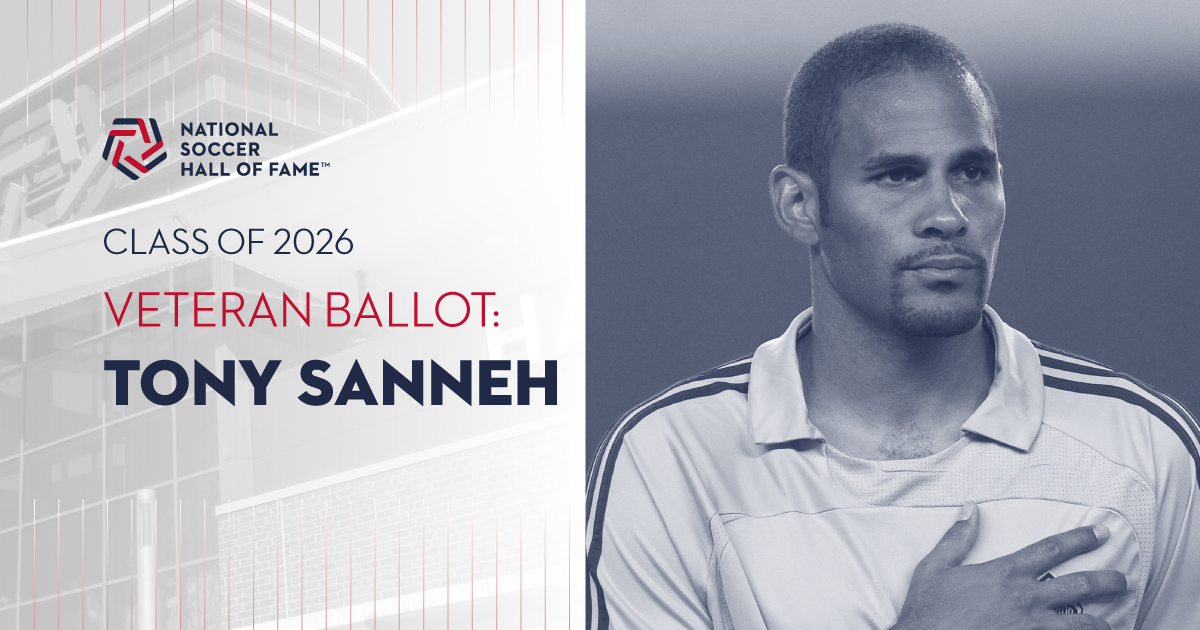
Tony Sanneh Elected to National Soccer Hall of Fame

Whenever his team needed a goal or a superior performance, Tony Sanneh found a way to step up his game.
In the first MLS Cup in 1996, Sanneh came off the bench to score a goal, sparking D.C. United’s historic 3-2 comeback extra-time victory over the LA Galaxy.
A year later, in Major League Soccer’s second championship game, Sanneh did himself one better, scoring once and assisting on another goal in a 2-1 win over the Colorado Rapids.
And during the 2002 World Cup in the Korea Republic, he played the games of his life as the U.S. Men’s National Team reached the quarterfinals.
That’s just the Reader’s Digest version of Sanneh’s accomplishments, which included 43 appearances and three goals for the USMNT.
When Sanneh was inducted into the Bud K. Haidet Hall of Fame at the University of Milwaukee in 2022, former head coach Brian Tompkins cited three special qualities: as an athlete, as a competitor and as a leader.
“He did have that grace and agility and power and strength,” Tompkins said on the school’s website. “We nicknamed him the Big Cat because of that. When you watch him run, it was just breathtaking to see him run past people. I’ve coached hundreds of young men and women over the course of the past 30 years, and I don’t know that I’ve ever met anybody with a more well-defined sense of wanting to win than Tony.”
Sanneh will have an opportunity to receive more praise when he is inducted into the National Soccer Hall of Fame on May 1, 2026, in Frisco, Texas. He was elected via the Veteran ballot.
Versatility defined Sanneh’s career as he played several positions, whether it was up front, in the middle or on the backline. He also starred in two versions of the sport — indoor and outdoor — and on both sides of the Atlantic.
Sanneh was born on June 1, 1974. His father hailed from Gambia and his mother from Wisconsin. He became hooked on soccer when he visited his father in Africa as a 6-year-old.
He became a lethal attacking player at whatever level he played.
Franklin Tawah, a longtime friend who was his coach and a big brother figure, realized that he had a special player in Sanneh.
“Of all the young players I have coached in Minnesota, Tony is the only one I’ve told he was going to play professional soccer,” Tawah told the Minneapolis Star Tribune in 2002. “It’s something you can’t describe. He was so driven. There was something internal. You could always tell.”
He excelled for the St. Paul Academy and Summit School and the St. Paul Blackhawks before starring for the University of Milwaukee, where he became the school’s career scoring leader with 53 goals and 32 assists. He earned NCAA Division I second team All-American honors in 1993.
Before MLS kicked off in 1996, the 6-foot-2, 190-pound Sanneh found ways to earn money playing the game he loved so much. He was a standout for the Milwaukee Rampage of the U.S. Interregional Soccer League (precursor to the United Soccer League), striking for 14 goals and 14 assists. He performed indoor for the Chicago Power of the National Professional Soccer League, tallying 27 goals during the 1994-95 season. He joined the Minnesota Thunder (USISL) for the 1995 campaign and ripped the net 18 times in 16 games.
“He’s very strong on the ball and has very good technique,” Thunder coach Buzz Lagos told the Star Tribune in 2002. “I wouldn’t call him fast in a short stretch, but overall, he can run with anybody.”
Sanneh was never a braggart, but he knew what he brought to the pitch.
“I was always confident in my abilities, no matter where I was playing,” he told the Star Tribune. “Every time I set a goal, it would be to be the best that season, and once I got there I’d move on. The more you have, the more you want. I was always chasing the dream.”
He joined D.C. United in 1996 and played right midfield, recording four goals and eight assists, that season. He added five goals and 11 assists in 1997.
That opened the door for several memorable moments.
In the inaugural MLS Cup in 1996, he came off the bench to tally the first goal in United’s late comeback from a 2-0 deficit to defeat the Galaxy. After replacing John Maessner in the 59th minute, he headed Hall of Famer Marco Etcheverry’s free kick past goalkeeper Jorge Campos in the 74th minute.
In the 1997 Eastern Conference semifinal series opener, Sanneh struck early and late in the opening half in United’s 3-2 home win over the Columbus Crew. He managed to beat the clock, redirecting John Harkes’ header past Hall of Fame goalkeeper Brad Friedel with three seconds to spare.
Several weeks later, Sanneh assisted on Hall of Famer Jaime Moreno’s 37th-minute goal and put away the second goal off another Harkes feed in the 68th minute.
“Anything less than this would have been a failure this year with the personnel we have,” Sanneh told reporters. “It just feels great, a sense of accomplishment. We were the favored team from the beginning to the end of the year.
“It was a little bit of a burden that way, and it’s a big sigh of relief at the same time. I would say we’re the best.”
And that’s not to forget the 2002 World Cup.
A stalwart for the team through qualifying, where he started 14 of a possible 16 matches, Sanneh said it was the “most vivid memory of soccer was during the national anthem of my first World Cup game,” he told the Star Tribune in 2023. “I looked up and saw that my mom and a lot of friends came to support me. But also thinking back and reflecting on everybody that was there for me.
“It was that one moment where me and every supporter connected, showing the world we reached our goal together.”
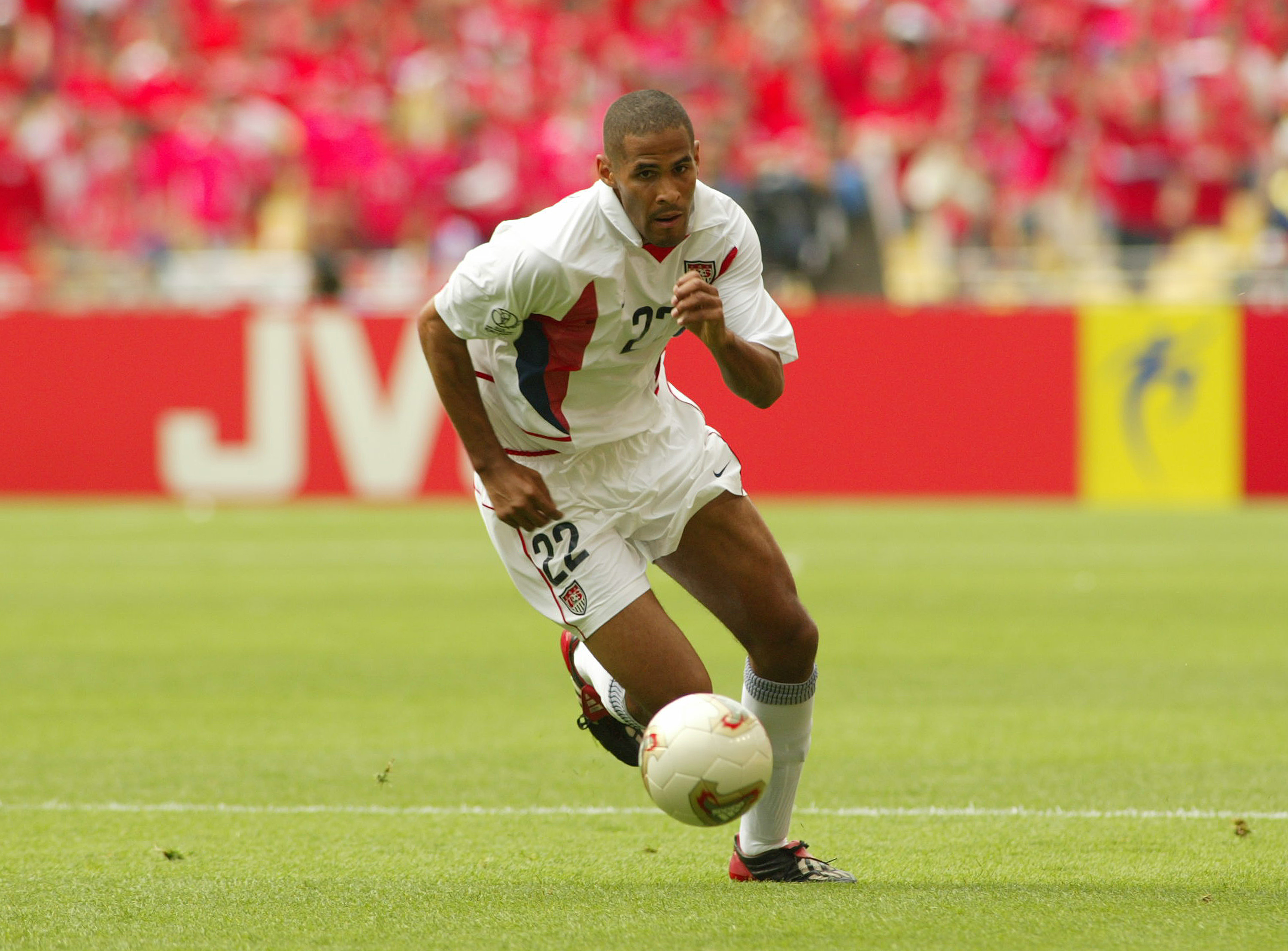
Sanneh sparkled for the U.S. as one of three players who competed in every minute of every match while receiving praise from former USMNT legends and the media.
Playing right back, he started by assisting on Brian McBride’s goal in a 3-2 upset triumph over Portugal in the team’s opening match. The play was one that he and McBride had patented during their time together at the Milwaukee Rampage seven years earlier.
Another Hall of Famer, Tab Ramos, liked what he saw.
“I thought Tony Sanneh played maybe the best game I’ve ever seen him play for the U.S.,” Ramos wrote in a column in the Newark Star-Ledger.
Sanneh also stood out in the disappointing 1-0 quarterfinal loss to Germany, a game that was defined by a shocking no-call on a goal-line handball that should have given the U.S. a chance to equalize from the penalty spot.
It was doubly frustrating for Sanneh. He tried to stop Michael Ballack’s header that turned into the lone goal of the encounter.
“I thought I was going to head it away,” he told the Star-Ledger. “I didn’t jump high enough or get back enough. That’s why we’re going home and they’re playing.”
Sanneh also came close to equalizing, heading a Clint Mathis cross into the side netting in second-half stoppage time. The Stuart News in Florida gave Sanneh a 10 out of 10 for the game.
“A two-way tenor,” the newspaper said. “Won virtually every conflict and created several chances by finding space down the right-hand side. Should have scored twice in the final moments on unmarked headers. The second one, which hit the side-netting, was a heartbreaker.”
In 2012, the Star Tribune asked Sanneh what was the one thing that fans say to him that he would wish he would never have to hear again.
“The World Cup is in front of 2 billion people,” he replied. “The farthest the U.S. has gone is the quarterfinals, and we lost to Germany. With about 15 seconds to go, the ball came across and I headed it and it hit the side of the net. I missed by about that much. Every time I see a fan they say, ‘You were incredible. I loved watching you. If you [had] made that header, we would have ...’ and I’m like, ‘Yes. I know. I’ve got it. You don’t have to remind me.’ Woulda, coulda, shoulda.”
After helping United reach three consecutive MLS Cup finals, Sanneh challenged himself overseas, performing in the German Bundesliga for Hertha Berlin (1999-2001) and FC Nuremberg (2001-2004). He returned home in 2004, playing for the Crew, Chicago Fire, Thunder and Colorado Rapids, before retiring with the LA Galaxy in 2009. He helped the Crew to the Supporters Shield in 2004 and the Fire to the Lamar Hunt U.S. Open Cup title in 2006, assisting on the third goal in the 3-1 win over the Galaxy.

Sanneh also had great vision off the pitch. As a player in 2003, he started The Sanneh Foundation, a non-profit organization that empowers youth and underserved communities through education, mentorship and soccer-based programming. The organization has focused on advancing social change, providing free sports camps, academic support and nutritional programs.
“My mom was a social worker for 42 years, so I guess I grew up watching her support people,” he told the Star Tribune in 2023. “My dad’s from west Africa. I went to visit when I was little, and I saw the way that community was built — where everybody picked you up off the ground. Everybody spanked you and everybody hugged you. And so, I knew that I had a responsibility to do something.
“It was really building a network where I could build relationships. It started with a focus on soccer but then it became, ‘How do I build an organization built on developing relationships?’
“My goal for the kids is for them to feel like they have the support to reach their dreams. My mom told me that when I was a little kid, I asked, ‘Do you think I’m going to be anybody?’ And she told me I could be anything I wanted to be. The reason why I was able to do it was I had a support system behind me. I believe our biggest asset in this world is our kids. If we invest in them, they’re going to change the world.”
He also serves as a Sports Envoy on behalf of the Sports United Division of the U.S. Department of State’s Bureau of Educational and Cultural Affairs.
Sanneh owns and operates a soccer camp system in the Midwest and U.S. Virgin Islands and is a coach and consultant for club soccer team Minneapolis United. He also is a member of the board of commissioners of the Minnesota Ballpark Authority.
His ongoing service has not gone unnoticed.
In March 2025, Sanneh earned U.S. Soccer’s third annual Carla Overbeck Leadership Award. Named for the former U.S. Women’s National Team captain, it is an honor given to an individual who demonstrates “a unique ability to lead and guide others and who contributes to the success of an initiative that benefits those outside their own organization and places emphasis on collaboration within and among leadership.”
One year later, he will add another national honor when he is inducted into the National Soccer Hall of Fame.