
As the World Cup Returns, These USMNT Artifacts Tell the Story of How We Got Here

The World Cup will bring global attention to North Texas this summer, but inside the air-conditioned (!) National Soccer Hall of Fame, there’s a collection of reminders of how long the road to this moment actually has been.
The memorabilia tied to the U.S. Men’s National Team doesn’t just capture ephemera from matches and tournaments past. It captures the slow, steady growth of soccer in America — through eras when the sport occupied a smaller place in the national conversation than it does today.
Long before millions watched them play in packed stadiums and on streaming platforms, the U.S. men fought for relevance in a crowded sports landscape. The artifacts preserved in the Hall of Fame tell that story better than any statistic can.
The Jerseys
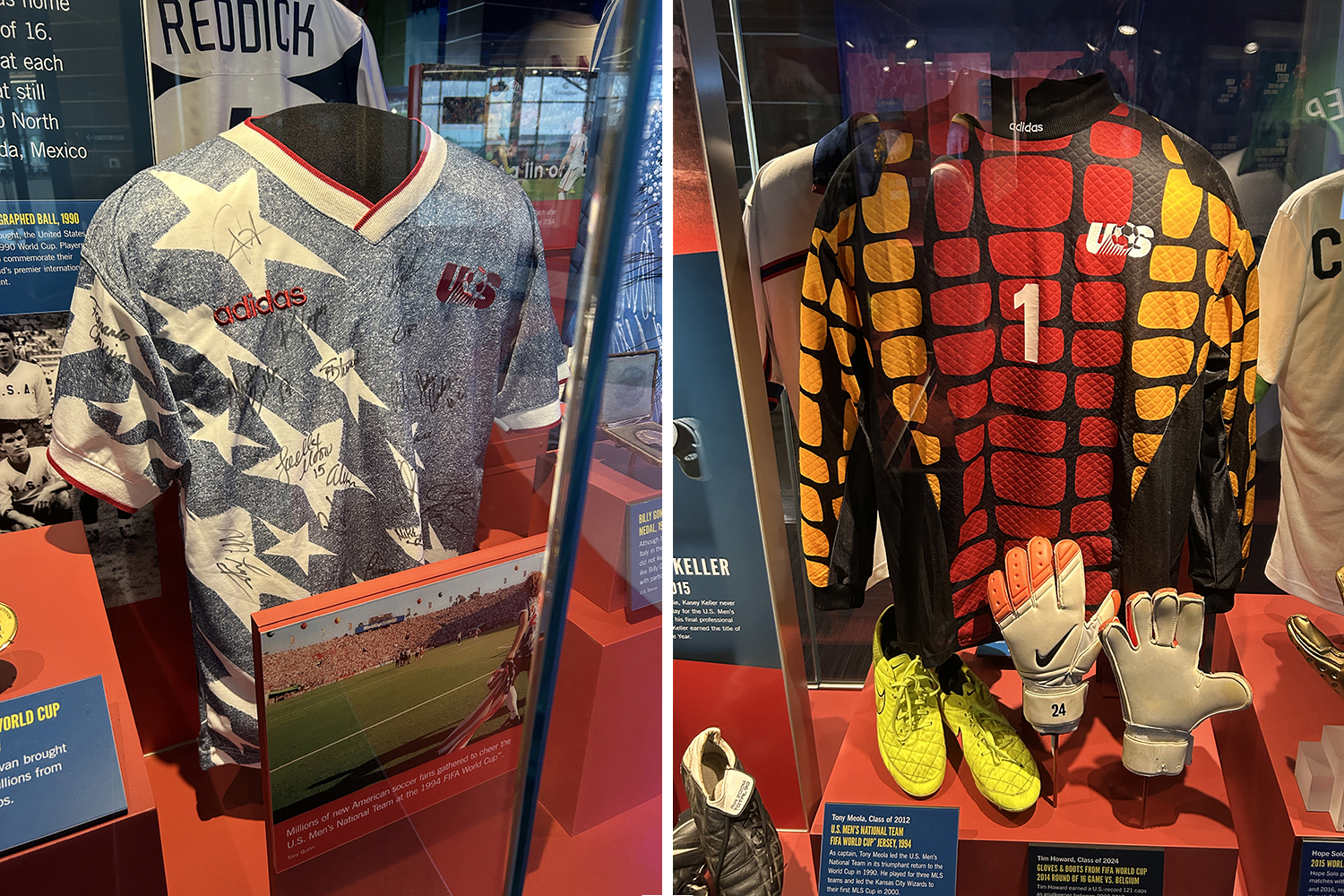
No collection of USMNT memorabilia would be complete with the iconic denim-style kit worn by the host nation during the 1994 World Cup, a now-familiar look that took a little getting used to for the players.
“The guys were just like, ‘Come on man, are you kidding me?’” midfielder Desmond Armstrong (Hall of Fame Class of 2012) told The Athletic. “‘Am I supposed to wear my Lee Jeans with these, playing in a game?’”
Forward Eric Wynalda (Class of 2004) recalled that goalkeeper Tony Meola (Class of 2012) had a similar reaction: “He turned to me and he just said, ‘Well hell, I’m happy I don’t have to wear that thing!’” (Meola’s goalkeeper jersey from the ’94 World Cup also is on display.)
Decades later, the jersey has become a symbol of ’90s culture and is forever tied to the moment that soccer exploded in this country. (You can also find the other 1994 jersey in a glass case, featuring waving stripes of red and white, worn and signed by Wynalda.)
Among the other cool finds: A 2006 World Cup jersey worn by Brian McBride (Class of 2014), a team-signed jersey from the 2002 World Cup squad, including newly inducted Hall of Famer Tony Sanneh (Class of 2026), Weston McKennie’s blue jersey from the 2022 World Cup match against England, and some truly vintage jerseys from the 1934 and 1950 tournaments.
The Gloves and Boots
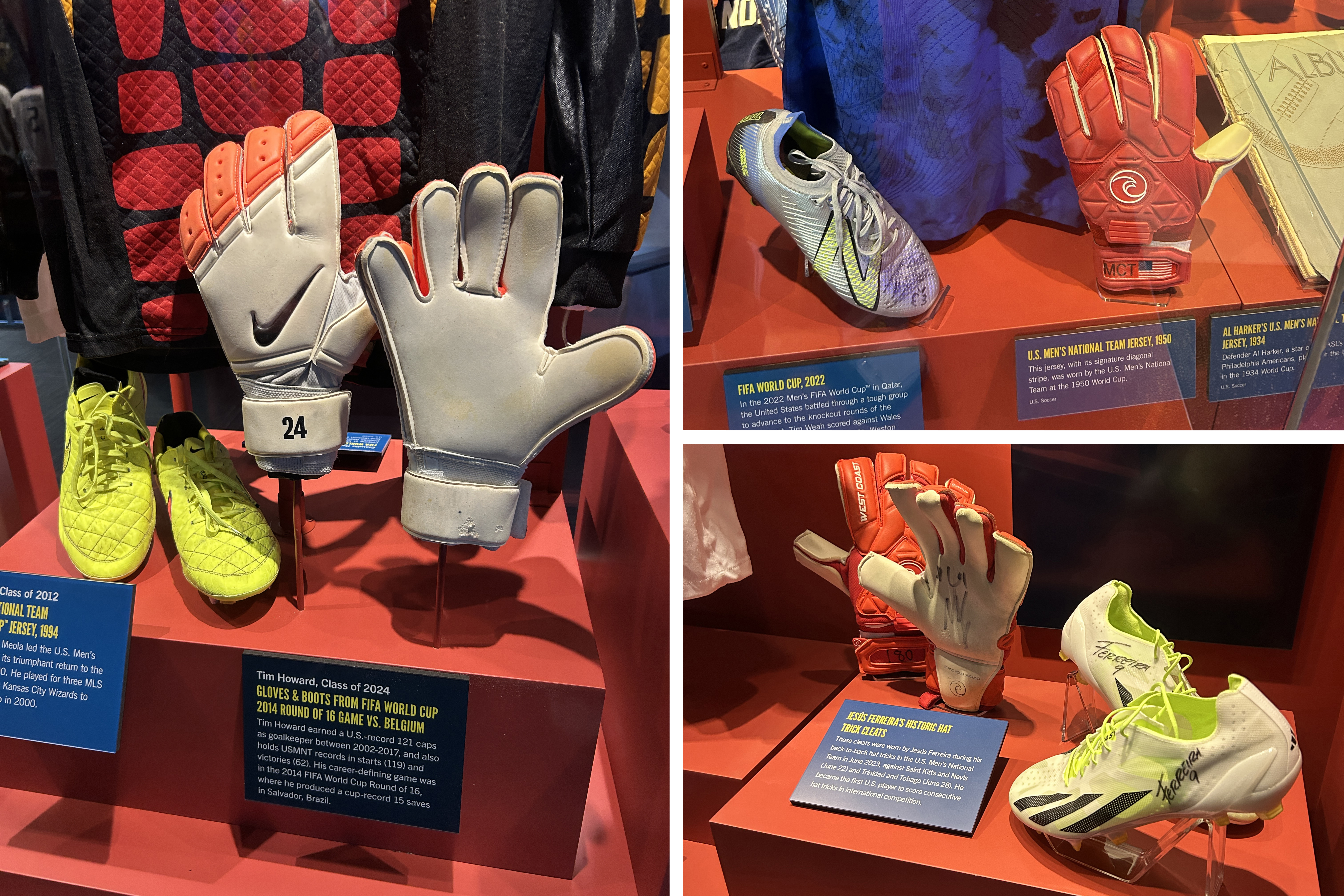
You can’t talk about the USMNT’s World Cup history without mentioning Tim Howard’s career-defining performance against Belgium in 2014. The Class of 2024 inductee set a World Cup record with 16 saves in a heartbreaking 2-1 defeat. His boots and well-used gloves are deservingly on display in a sacred spot in the Hall.
The boot Tim Weah wore on his right foot when he scored an impressive goal against Wales in the 2022 World Cup — the team’s first score in eight years — sits in a case with one of the gloves his teammate Matt Turner wore in a 1-0 shutout over Iran.
Fans of the USMNT’s modern era also may get a kick out of seeing the boots worn by Jesús Ferreira when he became the first U.S. player to score back-to-back hat tricks for his country in 2023. They share a spot in the Hall with the gloves Matt Freese wore when he made three saves in a penalty shootout against Costa Rica to help the U.S. advance to the semifinals of the 2025 Concacaf Gold Cup.
The Awards
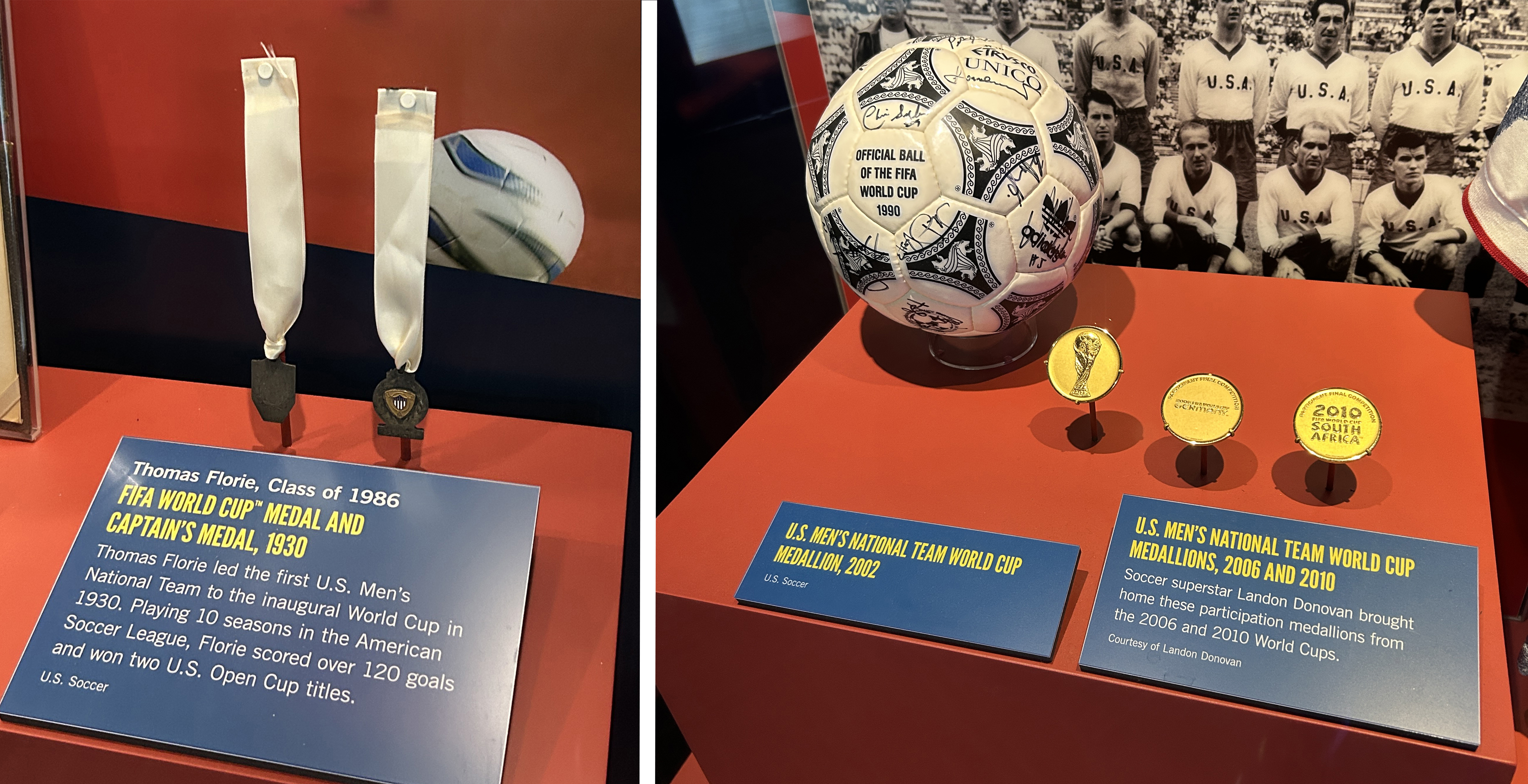
The trophy case is littered with cups and crystal — and of course, the four World Cup trophies won by the U.S. Women’s National Team. But with a closer study, you’ll find player medals going as far back as 1930, when captain Thomas Florie (Class of 1986) led the U.S. into action at the first World Cup.
These artifacts don’t just preserve soccer history in America. They help explain how the sport arrived at this moment — poised to explode yet again after a summer of showing what this country has to offer on the global stage.
National Soccer Hall of Fame tickets through June 24 are now available. All tickets are subject to cancellation and refund in the event of changes to Sweden’s training schedule. Tickets for June 25–July 19 will be released at a later date.