
The World Cup That Changed Soccer in America

One team, 15 Hall of Famers — and a legacy that still shapes U.S. soccer
It has been 32 years since the World Cup set attendance records on American soil, but the numbers still stand today: With 3.6 million spectators filling stadiums built for American football, that tournament remains the most attended FIFA World Cup in history.
The numbers set a benchmark for the sport’s reach, but they tell only a fraction of the story.
For many Americans, 1994 was the first time seeing the sport at its highest level, in person or on TV. What came next shaped the relationship between the U.S. and the Beautiful Game:
• Major League Soccer became a reality. FIFA required there to be a sustainable league in the U.S. as part of the country’s bid to host the Cup. As a result, MLS launched in 1996, filling the void left when the North American Soccer League folded in 1984.
• Player pathways expanded to the world’s top leagues. Before 1994, you could count the Americans playing top-flight soccer in Europe on one hand. The Cup raised Americans’ standard of play and visibility around the globe.
• The U.S. Men’s National Team gained credibility. By advancing out of the group stage for the first time since 1930, the U.S. showed the world that it could compete — and not just participate — at the highest level. The team earned a 2-1 win over Colombia and a draw against Switzerland before losing 1-0 to eventual champions Brazil.
In all, 15 players from that squad were inducted into the National Soccer Hall of Fame.
That doesn’t happen by chance. It happens when a generation meets a moment and makes an impact bigger than the game on the pitch.
The names are a Who’s Who of American soccer — and for a moment, they were fashion icons as well. (Who can forget the iconic denim kits?)
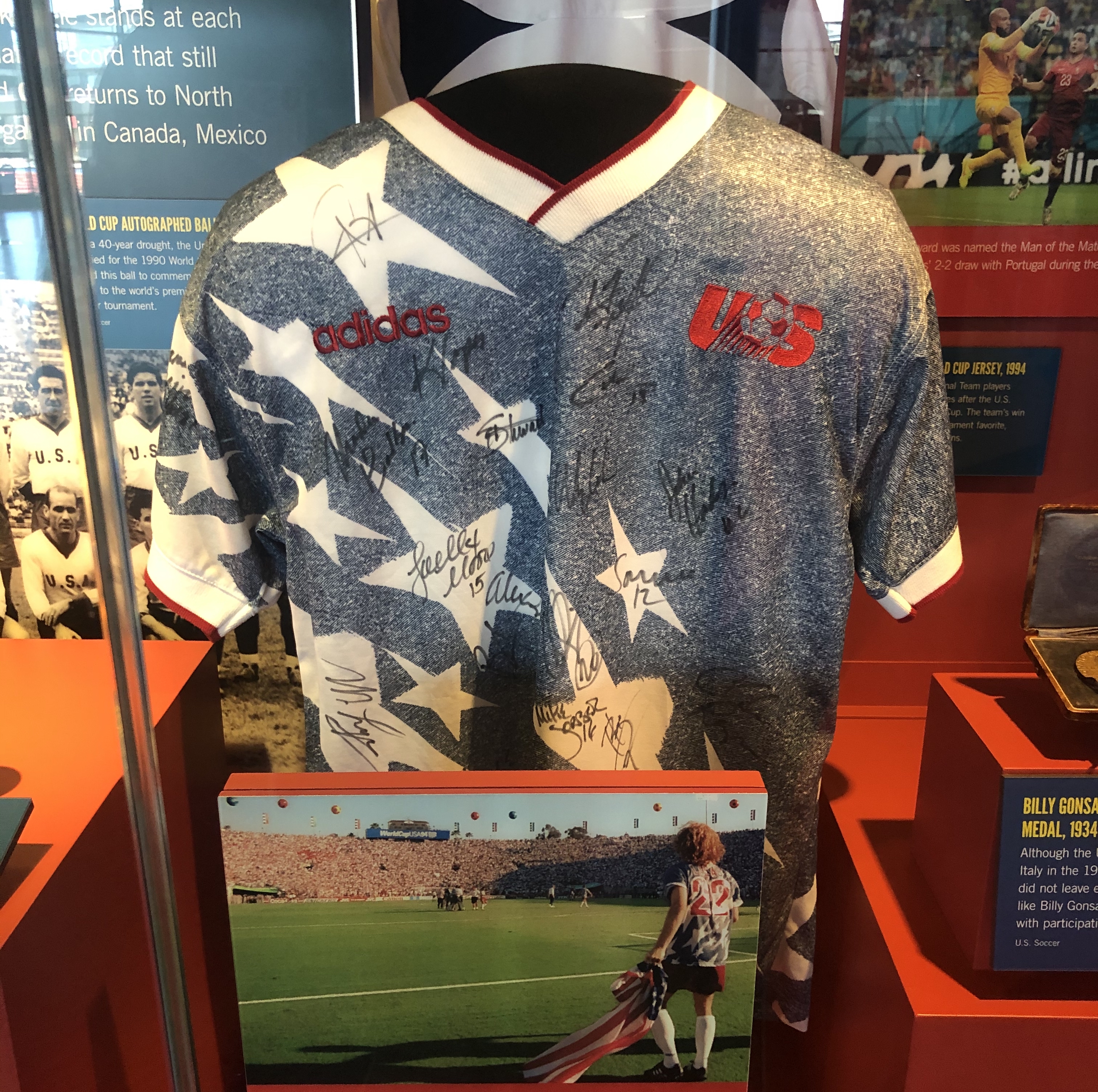
Goalkeeping was such a position of strength that two Hall of Famers came from the 1994 roster: Tony Meola (2012) and Brad Friedel (2018). Across the back, physical defenders showcased confidence and made an impact, led by Marcelo Balboa (2005), Fernando Clavijo (2005), Alexi Lalas (2006), and Thomas Dooley (2010).
There was technique and tactical skill across the midfield: John Harkes (2005), Tab Ramos (2005), Hugo Perez (2008), Earnie Stewart (2011), and Claudio Reyna (2012). And up top, ready to make the most of every opportunity, were dynamic forwards who delivered important moments: Eric Wynalda (2004), Paul Caligiuri (2004), Cobi Jones (2011), and Joe-Max Moore (2013).
+++
Welcoming the world that summer didn’t make America a global force in the game overnight, but it did change the trajectory of the sport. It created a league, raised expectations, and gave soccer new visibility.
And it created a new generation of Hall of Famers.
Consider Chris Wondolowski, who will be inducted with the Hall of Fame’s Class of 2026. He was 11 when the tournament came to America.
“Me and my friends went to watch Brazil practice,” he told The Sporting News. “We watched through a hole in the fence, and it was one of the most amazing things I’ve ever seen. I remember Ronaldo’s goal against Sweden, the final, the penalties.
“I remember thinking: I want this.”