
35 Years Later, the USWNT’s First World Cup Title Still Shapes the Sport

Two weeks ago, the U.S. Women’s National Team cruised to a 5-0 win over Chile in the cozy confines of UC Santa Barbara’s Harder Stadium. It was a dominant performance to kick off the season as the team prepares for the SheBelieves Cup in March.
The setting was not incidental. Harder Stadium was the site of the USWNT’s last exhibition matches before winning the first Women’s World Cup in 1991. It was a full-circle moment of sorts, a reminder of how today’s success was built on the foundation set 35 years ago.
The 1991 team, led by the “triple-edged sword” of captain April Heinrichs (inducted into the Hall of Fame in 1998), Michelle Akers (2004) and Carin Jennings (2000), showcased the impact of Title IX and laid the foundation for the global ecosystem of the women’s game.
+++
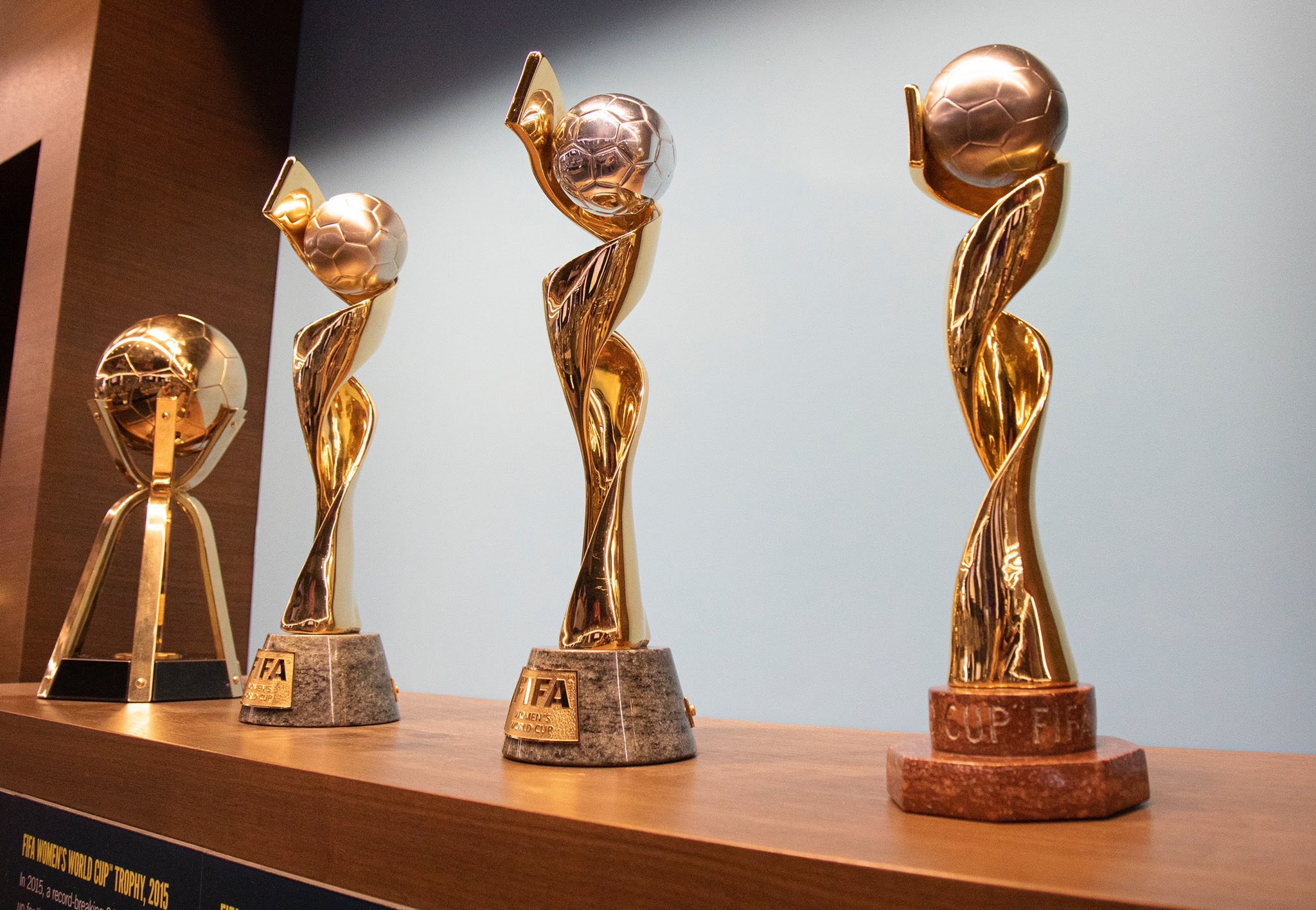
Want to visit the trophy?
The National Soccer Hall of Fame is home to all four of the World Cup trophies won by the USWNT: 1991, 1999, 2015 and 2019.
Plan your visit here.
+++
The players also played virtually for free, living on a $15 per diem and receiving a $500 bonus for capturing the sport’s top prize. Over the next three decades, the USWNT pushed for equal pay, and in 2022, the U.S. Soccer Federation agreed in a landmark move that was the first to incorporate World Cup prize money in its revenue sharing.
“The thought of making a living by playing soccer was so thoroughly out of the question,” goalkeeper Mary Harvey said during her induction speech in 2025. “You just retired and went to work, or you retired and went to school and then went to work, because we were all broke back then.”
The U.S. went undefeated during its 1991 title run, defeating Sweden, Brazil and Japan in the group stage and Chinese Taipei and Germany to advance to the final. Jennings won the Golden Ball as the tournament’s top player, and Akers led all scorers with 10 goals to claim the Golden Boot, including both U.S. scores in the 2-1 championship win over Norway.
“We weren’t winning for the money, obviously,” defender Linda Hamilton said during her Hall of Fame induction speech in 2022. “But we wanted to be competitors.”
+++
A Hall of Fame lineup
In all, 12 players from the 1991 squad — including the starting XI from the final match — and coach Anson Dorrance (2008) are in the Hall of Fame:
- April Heinrichs (1998)
- Carin Jennings (2000)
- Shannon Higgins-Cirovski (2002)
- Michelle Akers (2004)
- Carla Overbeck (2006)
- Julie Foudy (2007)
- Mia Hamm (2007)
- Joy Fawcett (2009)
- Kristine Lilly (2014)
- Brandi Chastain (2016)
- Linda Hamilton (2022)
- Mary Harvey (2025)
+++
Just six years earlier, the USWNT played its first match ever as one of four teams in the Mundalito (“Little World Cup”) in Italy. The squad trained together for only three days and wore hand-me-down uniforms from the men’s team. (The 1991 team played in their own kits for the World Cup, but the Adidas design was tailored for men and led to a larger, baggy fit.)
That squad went winless in Italy, but crowds seemed to fall in love with the team, chanting the now-familiar “Oosa!” for the first time, a reference to the USA lettering players sewed on their jerseys.
Lori Henry and Akers were the only ’85ers on the 1991 World Cup squad that included a 19-year-old Mia Hamm (2007) and 20-year-old Julie Foudy (2007). Hamm and Foudy joined Kristine Lilly (2014), Joy Fawcett (2009) and Carla Overbeck (2006) as the first players to win two World Cups when the U.S. held the trophy on home soil in 1999.
The ’99ers, widely regarded as the team that pushed the sport’s popularity into hyperdrive, joined the ’91 team and the ’85ers in building on the foundation laid in 1972 by Title IX, which mandated equal access to sports and educational programs for girls.
Before Title IX, there were 13 women’s college soccer teams. Today there are more than 1,500 teams in all divisions and more than 44,000 players — and women play in top-tier professional leagues in the U.S., England, Spain, France, and Germany, among other nations.
Growing up in a time when girls typically had to join boys’ teams in order to play the game instilled a sense of purpose in many of the players who would grow up to play in the 1991 World Cup.
“We were always told, ‘No, you can’t do that,’” Jennings said in an interview. “You can’t play sports, you cannot wear those clothes, you cannot be an athlete, you can’t. … If we wanted something, we had to make it happen.
“So we had this burning desire that was borne out of the adversity that we collectively went through.”